News
Forty years of the LBSE: assessing a cycle of seminars
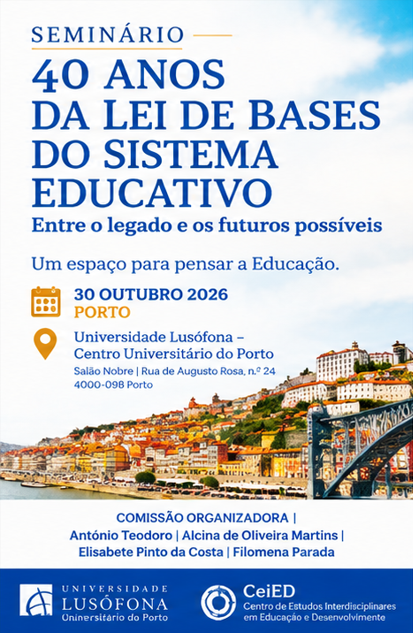
The four seminars dedicated to the 40th anniversary of the Framework Law on the Education System (LBSE), held in October in Lisbon, Funchal, Évora and Porto, made it possible to revisit the path of education in Portugal and to question its possible futures.
The central idea of the event, an initiative promoted by the research centres of Universidade Lusófona (through CeiED), the University of Madeira and the University of Évora, and held under the High Patronage of the Presidency of the Republic, is that the LBSE is a landmark in the democratisation of education, but putting its principles into practice continues to require political choices, resources and the transformation of educational practices.
The path travelled
The expansion of compulsory schooling, the growth of pre-school education, the reduction of school dropout and illiteracy, and the expansion of higher education were highlighted. The experience of Madeira showed how regional autonomy made it possible to develop tailored responses.
Inequalities that persist
Wider access has not eliminated inequalities: social background, territory and school resources continue to shape pathways and opportunities. The question is no longer simply to get everyone into school, but to ensure that each person finds there the conditions to learn, participate and develop.
Cross-cutting themes
The teaching profession was identified as a decisive condition for any transformation, with warnings about teacher shortages and the risk that emergency responses become permanent. On the curriculum, the gap between principles and practice was debated, along with the need to preserve the place of knowledge and time for learning. Also discussed were autonomy and democratic participation, with warnings about the erosion of democratic school management, as well as the mission of higher education and the organisation of the network.
Four tensions
The debate was shaped by tensions between:
- the stability of the democratic commitment and the need for updating;
- selection and inclusion;
- the purposes of education, which cannot be reduced to employability;
- pedagogical transformation and administrative rationality.
Questions for the future
Rather than choosing between preserving the law or changing it, the seminars suggest that the challenge is to renew the commitment to its democratic aims and to examine whether existing structures, resources and practices make them achievable for every person. Open questions remain about the revision of the law, effective inclusion, the organisation of educational pathways, teachers’ professional agency, the common curriculum, school governance and the place of artificial intelligence in learning.