Events
Expression of Sorrow and Condolences | José Bernardino Duarte
The Board of the Institute of Education and the Interdisciplinary Centre for Studies in Education and Development (CeiED) of Lusófona University fulfils the painful duty of informing the passing, in the early hours of 29 May 2026, of our colleague and friend, Professor José Bernardino Pereira Duarte.
Professor José Bernardino Duarte dedicated his entire life to education, teaching and teacher training, leaving a profound mark on several generations of students, researchers and lecturers.
Associate Professor at Lusófona University since the academic year 1998-1999, he developed a long and remarkable academic and pedagogical career, teaching, among others, the subjects Introduction to Educational Sciences, Educational Theories and Practices, Observation of Educational Contexts and Adult Education and Training, in the Degree in Educational Sciences. He also taught the modules Epistemology of Social Sciences and Educational Sciences in the Master’s in Educational Sciences, and Curriculum: Theories, Strategies and Evaluation in the Master’s in Educational Administration and Regulation, of which he was, together with Maria do Carmo Clímaco, creator of the innovative master’s project.
Before joining Lusófona University, he held teaching positions at the Faculty of Psychology and Educational Sciences of the University of Lisbon, at the Higher School of Education and at the Lisbon Teacher Training School, and was also a Portuguese Language teacher in secondary education (Emídio Navarro Secondary School, Almada). His professional trajectory thus crossed different educational levels and contexts, always marked by intellectual rigour, attention to students and a deep commitment to public education and the democratisation of education.
As a researcher at CeiED, he developed work in the fields of educational sciences, curriculum, teacher training, epistemology of social sciences and analysis of educational situations. He coordinated the project School Textbooks and Student Activities and authored numerous scientific articles published, among others, in Revista Lusófona de Educação and Entrelugares, from the Federal University of Ceará. Among his most recognised works is The Hidden Protest. Young People's Criticism of Today's School (Cortez, São Paulo, 2005), a landmark study on the silent suffering and existential failure of apparently successful students within the school system.
Throughout decades of university teaching, he supervised dozens of master’s dissertations and doctoral theses, accompanying, with rare intellectual and human generosity, multiple academic and professional paths. Many of today’s researchers, teachers and educational leaders retain the memory of a demanding, cultured, attentive supervisor who deeply respected the uniqueness of each student.
A man of vast culture, refined pedagogical sensitivity and great personal discretion, José Bernardino Duarte will remain in the memory of Lusófona University as an exceptional professor, a committed researcher and a colleague of extraordinary humanity.
To his family, friends, colleagues, disciples and all those who had the privilege of learning and sharing moments with him, the Board of the Institute of Education and CeiED extends its deepest condolences.
Lisbon, 29 May 2026
António Teodoro
Director of the Institute of Education and CeiED
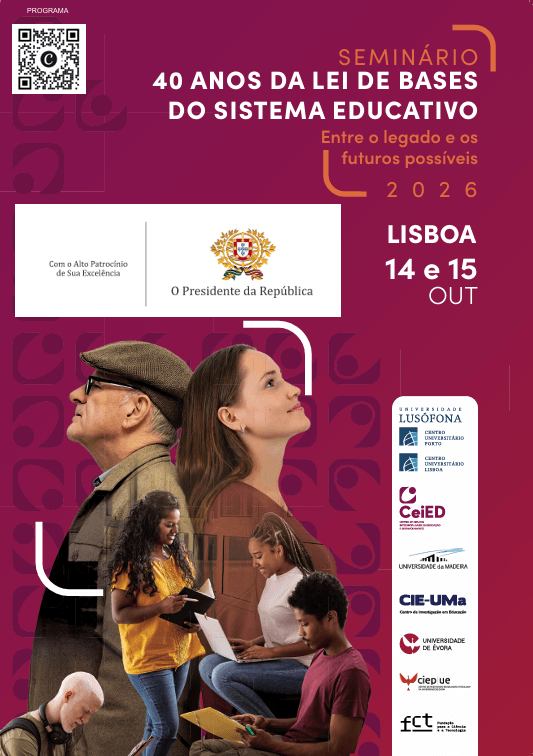
Call for Papers - Lisbon | Seminar: 40 years of the Basic Law of the Education System
Lusófona University, Lisbon, October 14 and 15, 2026
Four decades after the approval of the Portuguese Framework Law of the Education System, a moment of reflection is necessary. Between celebration and debate, between evoking the past and problematizing the present, there are choices to be made. In a context where public debate on education tends to be fragmented, technocratic, or subordinated to short-term agendas, it becomes essential to refocus the discussion on major political options and their foundations. This seminar aims, therefore, to constitute a broad, plural, and participatory forum, involving researchers, teachers, students, education system professionals, and institutional leaders.
The central question guiding the seminar is: What kind of Framework Law do we need today, not just as a legal instrument, but as a political, social, and educational project to respond to the contemporary challenges of education?
More than marking a historical milestone, the seminar aims to create a space for public discussion about education policies in Portugal. The Framework Law should not only be remembered as a founding reference, but questioned in light of the social, economic, cultural, and technological transformations that have marked the last 40 years and, above all, those that shape our future.
The seminar aims to value the contribution of new generations of researchers to the analysis and understanding of the Portuguese education system. Thus, it encourages the participation of young researchers through the submission of works based on completed or ongoing master's dissertations and doctoral theses.
We invite the submission of communication proposals that address the following themes:
1) The Framework Law as a democratic project: purposes, citizenship, and the common good
The purposes of education today in a context of polarization, inequalities, and transitions (climate, digital, labor): democracy, rights, pluralism, the common good, sustainability.
Topics:
- school as a public space;
- democratic citizenship (participation, debate, critical thinking);
- global citizenship/sustainability;
- education and decent work;
- tensions between neutrality, pluralism, and public controversy;
- the public role of the university and its relationship with society.
2) Reconfiguration of the education system and territorial equity
System architecture and coherence between cycles, purposes and organization of education.
Topics:
- integration of 0-3-year-olds into the education system;
- universalization of preschool (Law No. 22/2025) and expansion/partnerships;
- articulation between preschool, basic and secondary education;
- reorganization of cycles (including the merging of 1st/2nd cycles);
- differentiation, convergence and mission of higher education;
- reconfiguration of the architecture of levels;
- territorial inequalities and capacity of the public network.
3) Curriculum, knowledge and assessment: regulation and autonomy
Curriculum as a cultural and political construct. What counts as knowledge and how it is assessed, direct impact on equity.
Topics:
- Essential learning (regulation vs. autonomy);
- general education vs. vocationalism and early specialization;
- integration of academic and professional knowledge;
- interdisciplinarity;
- external assessment, regulation and quality;
- alternative models (formative, participatory, democratic).
4) Inclusion, diversity and educational justice changing
Intersection between school, territory and rights.
Topics:
- review of Decree-Law No. 54/2018 and new public policy scenarios;
- effective inclusion vs. formal inclusion;
- cultural/linguistic diversity;
- social inequalities;
- trajectories of risk and exclusion;
- NEET youth: characterization, causes and public policies;
- curricular justice and recognition;
- organizational conditions and resources for inclusion;
- inequalities in access to higher education.
5) Teaching profession and governance of educational work
Regulation and reconfiguration of the teaching profession.
Topics:
- identity, mission and conditions of practice;
- professional qualification and entry into the profession;
- Teaching careers: attractiveness, progression and recognition;
- Educational teams: from individual work to collaborative work;
- co-teaching: models, possibilities and constraints;
- Organization of pedagogical work: time, spaces and professional cultures;
- Articulation between teaching, research and innovation.
6) Digital transformation: Rights, learning, and democracy
Recent policies in the face of current challenges (AI, data, autonomy, well-being, and participation).
Topics:
- digital technologies and pedagogical practices;
- AI in assessment, curriculum, and teaching work;
- Impacts on learning, cognition, and autonomy;
- prohibition/restrictions on the use of mobile phones and their effects;
- ethics, privacy, and surveillance;
- digital inequalities;
- media literacy and democracy;
- technology as control vs. emancipation.
Proposal Submission
- Submission deadline: July 10, 2026
- Format: Abstract up to 500 words
- Language: Portuguese
- Notification of acceptance: September 8, 2026
- Registration deadline: September 22, 2026
Submissions must be made through the Event3 platform:
Participation Costs
Participants with communication
| Students | 20€ |
| Researchers from the organizing centers or researchers associated with entities that support the event | 60€ |
| Remaining researchers | 120€ |
Participants without communication
| Students | 10€ |
| Researchers from the organizing centers or researchers associated with entities that support the event | 20€ |
| Remaining researchers | 30€ |
Organization
- CeiED – Interdisciplinary Research Center on Education and Development, Lusófona University
- CIE-UMa – Education Research Centre, University of Madeira
- CIEP – Research Center on Education and Psychology, University of Évora
With the support of
- Associação Portuguesa de Sociologia (APS)
- Sociedade Portuguesa de Ciências da Educação (SPCE)
- Associação de História da Educação de Portugal (HISTEDUP)
- Fórum Português de Administração Educacional (FPAE)
- Associação Nacional de Docentes de Educação Especial (Pró-Inclusão)
Contacts
For further information, please contact:
Seminar | Teacher Performance Evaluation: Policies, Practices and Effects
Local
Agostinho da Silva Auditorium
Lusófona University of Lisbon
The National Council of Education, in partnership with Lusófona University of Lisbon, is organising the Seminar “Teacher Performance Evaluation: Policies, Practices and Effects”.
Teacher performance evaluation is a complex and often controversial topic, yet one that plays a decisive role in improving the quality of education. In general terms, it seeks to understand how evaluation can contribute to improving teacher quality, teaching practices and, consequently, students’ learning and academic outcomes.
This perspective requires reflection on its principles and assumptions, its procedures and methods, the purposes it serves and its effects (both intended and unintended). Within this framework, discussions arise, for example, around the possibility of reconciling summative purposes focused on career management with formative purposes focused on teachers’ professional development within the same evaluation system.
Thus, the debate surrounding teacher performance evaluation includes consideration of teacher professionalism, the teacher profile and its framework within the teaching career statute, as well as the way evaluation is conceptualised and operationalised.
It is with the aim of discussing this topic that the National Council of Education is organising this Seminar, where, from both national and international perspectives, the policies, practices and effects of teacher performance evaluation will be debated, considering their relevance in the current context and their ethical, methodological and pedagogical implications.
Programme
08:45 | RECEPTION
09:15 | OPENING SESSION
-
António Teodoro
Director of the Institute of Education and Scientific Coordinator of the Interdisciplinary Research Centre in Education and Development -
Maria Assunção Flores
Coordinator of the Specialised Committee on Teachers and Other Education Professionals
National Council of Education -
Domingos Fernandes
President of the National Council of Education -
Luís Cláudio Ribeiro
Vice-Rector of Lusófona University
09:45 | KEYNOTE LECTURE
Teacher evaluation as an integral part of strategic Human Resource Management in schools
Melissa Tuytens
Ghent University, Belgium
10:45 | COFFEE BREAK
Coffee
11:15 | CULTURAL MOMENT
Orquestra Geração from AE da Boa Água.
11:30 | PANEL 1
Teacher performance evaluation: theoretical and methodological perspectives
- Maria Assunção Flores — University of Minho
- Elsa Estrela — Lusófona University of Lisbon
- Beatrice Ávalos — University of Chile
- André Freitas | Moderator — Lusófona University of Lisbon
13:00 | LUNCH
14:30 | PANEL 2
Teacher Performance Evaluation
Policies, Practices and Effects
Teacher performance evaluation in context: experiences and challenges
- Anabela Leal — Felgueiras Secondary School
- Paulo Ferreira — Fernando Casimiro Pereira da Silva School Cluster - Rio Maior
- Maria João Lobato — Laranjeiras School Cluster - Lisbon
- Cristina Faria dos Santos — Director of CFAE Centro Oeste
- Cristina Bastos | Moderator — Member of the National Council of Education
16:00 | CLOSING SESSION
-
Maria Assunção Flores
Coordinator of the Specialised Committee on Teachers and Other Education Professionals
National Council of Education -
António Teodoro
Director of the Institute of Education and Scientific Coordinator of the Interdisciplinary Research Centre in Education and Development -
Domingos Fernandes
President of the National Council of Education
Como olhar junto by Luiza Baldan at NowHere Lisboa
The solo exhibition Como olhar junto by Luiza Baldan, visual artist and researcher funded by FCT — 2023.08863.CEECIND — at CeiED/Universidade Lusófona, is on view at NowHere Lisboa until 30 May.
Luiza Baldan’s project involves observation, listening, and collaborative research in a community library in Cova do Vapor, a small coastal settlement located where the Tagus River meets the Atlantic Ocean, whose landscape has been reshaped over the past century due to the advance of the sea. At NowHere, the artist presents the project’s book-object, a series of portraits printed on fabric, and a sound installation that re-enacts Primeira Praia during a performance held and filmed in October 2023. This same installation becomes a stage for a series of gatherings taking place throughout the exhibition, and has already been activated during the opening by the same participants from the original performance.
This project gave rise to Baldan’s broader academic research.
The programme includes a special “readings by the fire” session on 23 May, at 7 pm, with Duda Las Casas, Fernanda Drummond, Mariana Varela, Maura Grimaldi, and Tatiana Salem Levy. The session proposes cross-readings between excerpts from the project’s book-object and texts authored by the invited participants.
On 28 May, the artist will welcome a group of students from Voz do Operário for a visual and literary development workshop, with the participation of Diego Garcez, José Carvalheiro, Raphael Almeida, Yuli Anastassakis, Tánia Cardoso, and Rodrigo Crespo.
On 29 May, at 7 pm, NowHere invites the public to the closing event, with the presence of the artist and the curator and director of the space, Cristiana Tejo, for a guided visit and a public conversation around the project.
Admission is free and open to all audiences.
More information about the project:
https://luizabaldan.framer.website/comoolharjunto
More information about NowHere Lisboa:
https://www.nowhere-lisboa.com/
Conference World Portuguese Language Day, Portuguese Language and Culture Day in the CPLP
The conference “World Portuguese Language Day and Portuguese Language and Culture Day in the CPLP” aims to highlight the central role of language in Portuguese-speaking higher education and in strengthening relations between CPLP countries.
The future of education under discussion
Seminar "40 years of the Basic Law of the Education System: Between legacy and possible futures" celebrates the anniversary of the law through a nationwide programme
Lisbon, Funchal, Porto and Évora will host, in October 2026, a cycle of critical reflections on the legacy and challenges of the Portuguese education system.
In 2026, the Basic Law of the Education System (LBSE) marks four decades. To celebrate this decisive milestone in the democratisation of education in Portugal, the seminar "40 years of the Basic Law of the Education System: Between legacy and possible futures" will travel across the country with a programme combining historical analysis and debate on contemporary challenges.
The event proposes discussion forums on the evolution of educational policies since 1986, addressing the following themes:
- The Basic Law as a democratic project: purposes, citizenship and the common good
- Reconfiguration of the education system and territorial equity
- Curriculum, knowledge and assessment: regulation and autonomy
- Inclusion, diversity and changing educational justice
- The teaching profession and governance of educational work
- Digital transformation: rights, learning and democracy
Dates and locations
19 October 2026
29 October 2026
30 October 2026
The seminar aims to be a plural forum directed at researchers, including students and early-career researchers, teachers from all levels of education, education professionals and school managers, institutional representatives and policy makers.
For the Lisbon seminar (14–15 October), all interested participants are invited to submit paper proposals within the themes mentioned above by 10 July 2026. More informações in Call for Papers - Lisbon.
Para o seminário de Lisboa (14-15 de outubro) convidamos todos os interessados a submeterem propostas de comunicação, dentro das temáticas referidas acima, até ao dia 10 de julho de 2026. Mais informações em Chamada de comunicações - Lisboa.The organisation is led by a partnership between CeiED (Lusófona University), CIE (University of Madeira) and CIEP (University of Évora), with the support of the main scientific and professional associations in the field of education in Portugal.
For further information, contact: