News
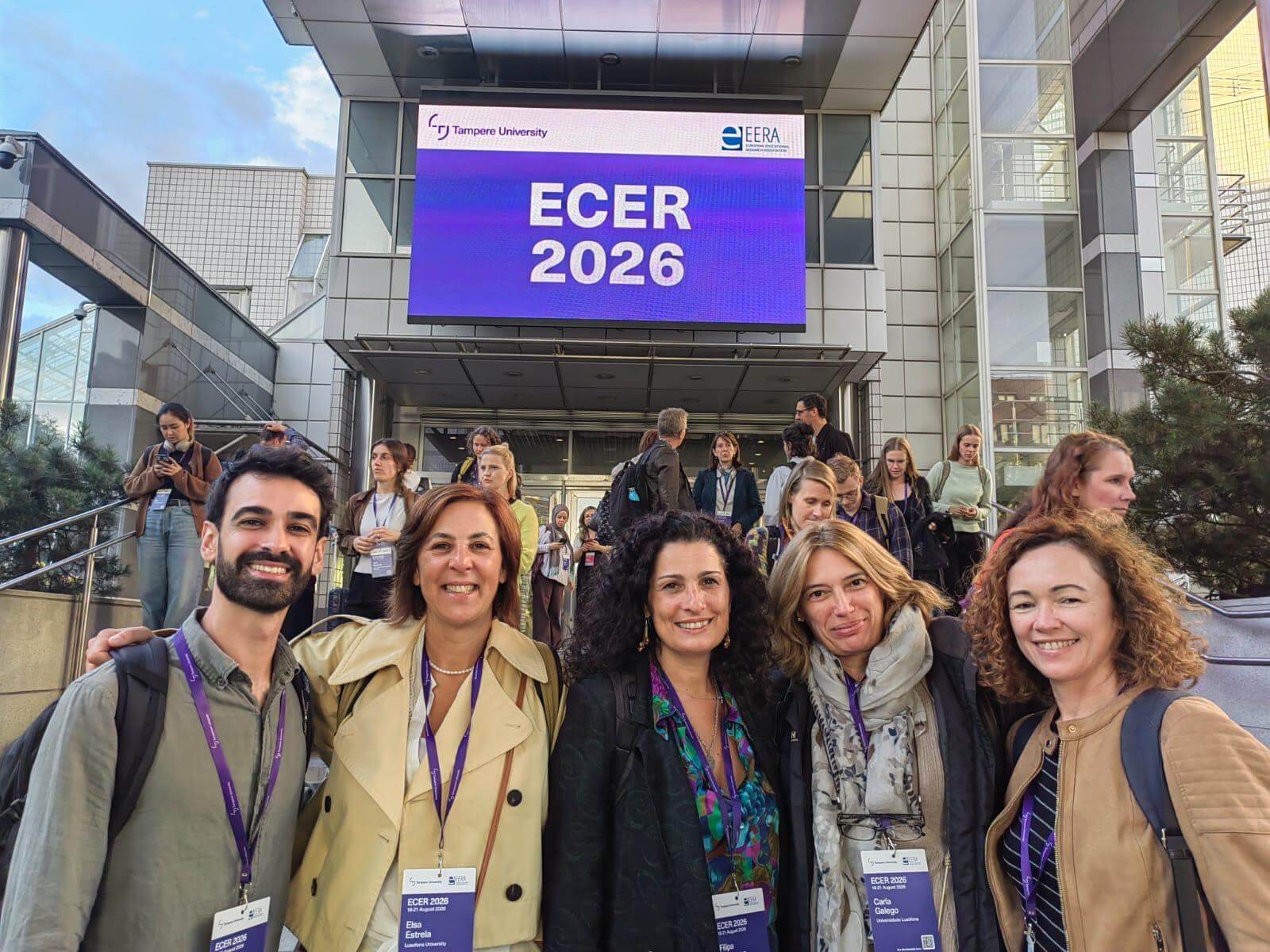
CeiED attends ECER 2026 in Tampere, Finland
Under the theme Knowing and Acting: The changing conditions and potentials of education research, the European Conference on Educational Research 2026 (ECER 2026) took place between August 18 and 21 at the University of Tampere, Finland. Organized by the European Educational Research Association (EERA) together with the Faculty of Education and Culture at the University of Tampere and the City of Tampere, this edition broke participation records with around 4,000 researchers from all over Europe and the world, and more than 4,400 submitted abstracts, the highest number ever in the history of a conference held since 1992.
CeiED was present with five researchers, who presented six communications:
André Freitas presented results from the research project Educação Digital Inclusiva: Atelier de Práticas Reflexivas em Ética Digital at the symposium Beyond Bans: European Policy Responses to Children's Digital Lives - Restriction, Empowerment, or Trust?, in collaboration with researchers from France, the United Kingdom, and Norway. His communication, co-authored by João Filipe Matos and Alcina de Oliveira Martins, K-12 Students' Experiences of Digital Ethics in Portuguese Schools: Digital Citizenship Education as Political and Ethical Care, discussed digital citizenship education as a form of political and ethical care with primary and secondary education students in Portugal. André Freitas also presented, as part of an international mobility at Dublin City University and in partnership with Eamon Costello, results from the project Future-oriented Stories of Digital Schools' Capital: Imagining Times, Places and Sociabilities of Education, with the communication Reclamation of Socio-technical Imaginaries amid Empty Places and Silences in K-12 Digital Teaching and Learning Practices.
Carla Galego presented, within Network 31 - LEd (Language and Education), the work Language Skills, School Context, and Critical Thinking in Portuguese Upper Secondary Education: A Sociological Analysis of Public School Data, developed under the research project LINKING | Neuroscience and Education Perspectives on Language Ability and Critical Thinking: An Interdisciplinary Approach, coordinated by Lucimar Dantas, in partnership with HEI-Lab, the Linguistics Center of the University of Lisbon (CLUL), and the Gulbenkian Institute of Science.
Lucimar Dantas, within the framework of the same research project, presented the work Language as Cognitive Tool: Writing Skills and the Development of Critical Thinking in Upper Secondary Education, dedicated to the role of writing as a central cognitive tool in the development of critical thinking among secondary education students.
Elsa Estrela presented, in Network 3 - Curriculum and as part of an international mobility at the University of Stirling, in collaboration with Mark Priestley, results from the project Teachers’ professionalism: processes of transformation and learning – ProTAg with the communication Beyond the Classroom: A Comparative Ecological Analysis of Teacher Professionalism in Portugal and Scotland. Elsa Estrela was also co-author of the work presented by Susana Oliveira, student of the PhD in Education at Universidade Lusófona - Centro Universitário de Lisboa, entitled Attending to What Appears: Arts-based and Artistic Research Practices as Methodological Gestures in Educational Inquiry, within Network 29 - Research on Arts Education.
Filipa Lourenço presented, in Network 7 – Social Justice and Intercultural Education, the work The Sensible Dimension in the Epistemological Debate: An Alternative Barometer for Social Justice and Intercultural Education. The presentation proposed a reflection on the marginalization of the sensible dimension in knowledge production and the need to rethink educational models from an epistemic justice perspective.
In addition to their presentations, the researchers had the opportunity to participate in the Network meetings corresponding to their fields of work, providing opportunities for networking, establishing global connections, and sharing knowledge. These six interventions reinforce CeiED's commitment to sharing research findings at the main international conference in education, as well as the Center's focus on international cooperation and the internationalization of its researchers.