News

Rosa Serradas Duarte and André Robert at the IV Meeting of the AST

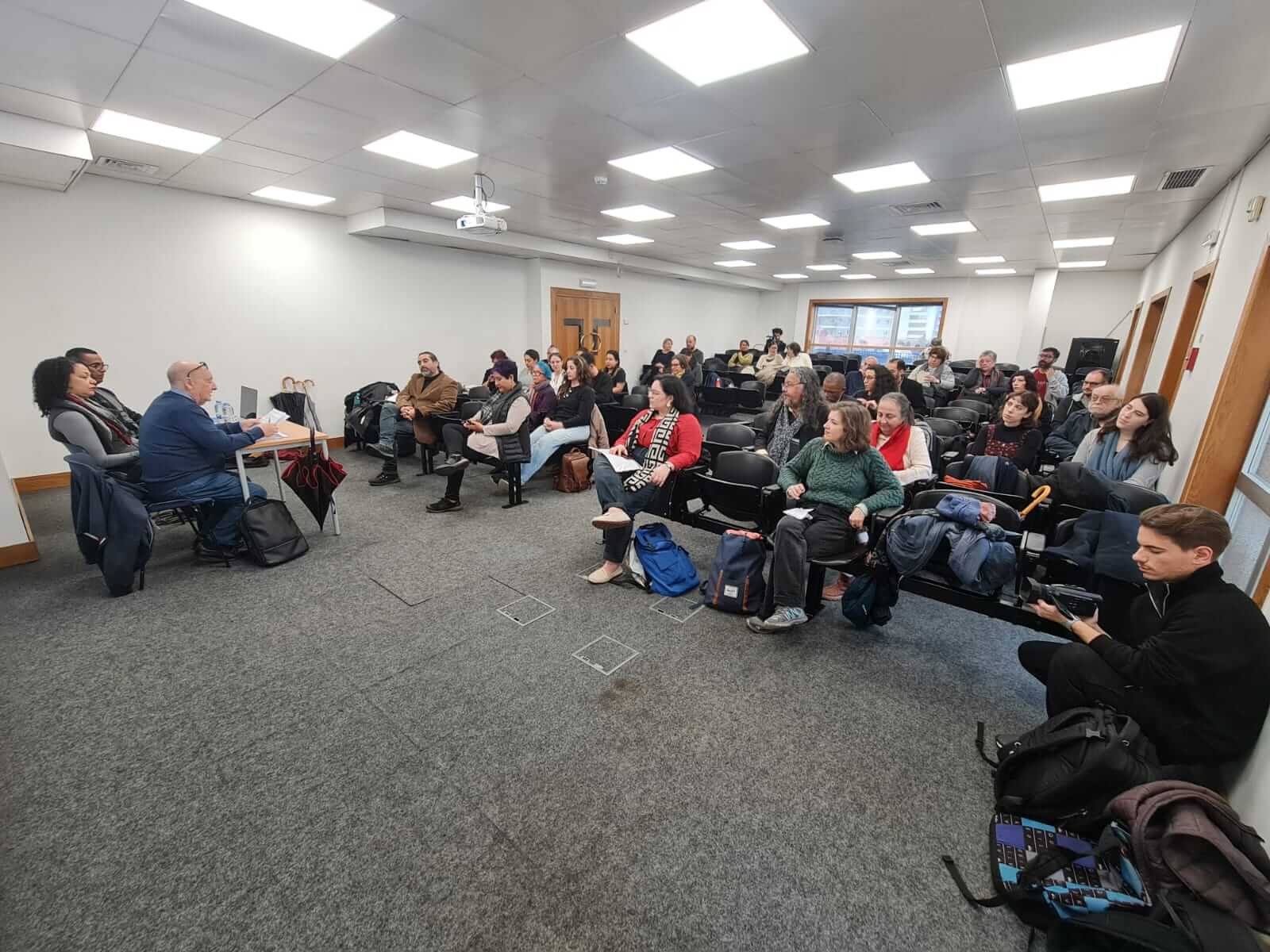
On December 13, 2024, Rosa Serradas Duarte, researcher at CeiED, and André Robert, a member of the External Advisory Board participated in the VI São Paulo Meeting of the ASTE Network. They led a session titled “The Influences, Consequences, and Possibilities of Overcoming Neoliberalism in Education?” The session was coordinated by Adriana Migliavacca from the Universidad Nacional de Luján (Argentina).

The event, held for the first time at the Faculty of Science and Technology of the São Paulo State University (UNESP), Campus of Presidente Prudente, was co-organized by the Research Group on History and Theory of the Teaching Profession and Social Educators (GRUPHIS) of the Graduate Program in Education (PPGE) at the University of Nove de Julho (UNINOVE), in collaboration with the Research Group on Labor, Health, and Subjectivity (NETSS), from the Graduate Program in Education (PPGE) at the State University of Campinas (UNICAMP). The main theme of the event focused on the associative and unionist tasks in combating neoliberalism in education and active solidarity with the Palestinian people—calling for an immediate end to the human extermination in Gaza and the Cisjordânia.

The event took place in a hybrid format, with remote presentations of communications and posters, while roundtable discussions, working meetings, book launches, and academic conversation circles were held in person.

9 december 2024

The Revista Lusófona de Educação adopts a continuous submission model

The  Revista Lusófona de Educação (RLE) invites researchers and academics to submit their original works for publication. By adopting a continuous submission model, the RLE offers greater flexibility and agility in the process of submitting and publishing scientific articles.

With a long-standing tradition of disseminating knowledge in the field of education, the journal is committed to ensuring the editorial quality and scientific relevance of its published content. We welcome articles addressing current and innovative topics that contribute to advancing research in education and related fields.

How to Submit
Interested authors can consult the Instructions for Authors and submit their works online after registering on the RLE website at the following address: http://revistas.ulusofona.pt/index.php/rleducacaoThis continuous submission model allows approved articles to be made available to the public as soon as the editorial process is completed, ensuring the constant update of our content.

We invite the entire academic community to contribute their research and reflections to strengthen the scientific dialogue promoted by the Revista Lusófona de Educação.

9 december 2024

Briefing on Digital Ethics in Social Sciences 

André Freitas, a researcher at CeiED, recently published a briefing

9 dezembro 2024

Study reveals the transformative impact of international students' presence in rural regions of Portugal

A recently published article in the International Journal of Educational Research explores the significant impacts that international students have on rural areas in Portugal. The article, titled “Impact of international student mobility in rural Portuguese regions,” authored by Joyce Aguiar (Center for Research in Higher Education Policies), Orlanda Tavares (CIEC, University of Minho), and Cristina Sin (CeiED, Universidade Lusófona), highlights how the presence of international students brings not only immediate economic benefits but also contributes to demographic renewal, economic growth, and cultural dynamism in rural areas facing demographic and depopulation challenges.

The study reports that international students play a central role in revitalizing Portugal's more remote regions. Interviewees—representatives of four higher education institutions, three of which are located in rural areas—emphasized that these students help increase population diversity, aiding in counteracting the demographic decline that affects many rural areas of the country.

Additionally, the presence of international students has a direct impact on the local economy. On one hand, as active consumers of goods and services, these students help stimulate the real estate sector and other segments of local commerce. On the other hand, many of these students have demonstrated an entrepreneurial spirit, creating innovative businesses that meet unmet needs and add diversity to the economic landscape.

Another highlight of the study is the cultural impact that international students bring. In the regions analyzed, the arrival of these students is seen as a catalyst for greater sociocultural openness, breaking down barriers and promoting a more cosmopolitan mindset in local communities. Cultural events organized by the students, such as art exhibitions and musical performances, enrich the social life of the areas studied, providing a multicultural experience for both local residents and students alike.

While the benefits are clear, the study also identifies challenges. Many international students face difficulties integrating, including linguistic and cultural barriers, along with reports of discrimination and exclusion. These obstacles can limit students' ability to fully engage with the communities and take advantage of all the opportunities these regions offer.

The study concludes that higher education institutions in rural regions play a strategic role in regional development, but greater efforts are needed to fully integrate international students. Initiatives that promote interaction between students and the local community are essential to maximizing the economic and social benefits brought by the arrival of these students.

Full and free access to the scientific article, in English, is available here.

To cite this work: Aguiar, J., Tavares O., Sin, C. (2024). Impact of international student mobility in rural Portuguese regions. International Journal of Educational Research, 27. https://doi.org/10.1016/j.ijer.2024.102439

9 december 2024

Undergraduate Students Visit CeiED

On November 28th CeiED welcomed second-year students of the Bachelor's Degree in Educational Sciences/Social Education to its facilities in Lisbon, as part of the activities for the course unit Research in Educational Sciences.

This course is led by researcher Inês Vieira, who guided the students in exploring methodologies and research practices in the educational field.

Researcher Lucimar Dantas gave a presentation on the activities carried out by the R&D Center and on the ReLeCo (Research and Learning Communities). Lucimar highlighted her ongoing projects, which address crucial topics in the educational, social, and community domains, and explained the methods used in the research conducted by her and her team.

The meeting provided a unique opportunity for interaction between the students and professionals in the field, enabling the future educators/teachers/researchers to gain practical insights into how a research center is structured. The dialogue between the students and the Cent

2 december 2024

AGRRIN Project at the 1st MICAR - International Anti-Racist Film Festival

The AGRRIN Project – Generative Bodies: From Aggression to Insurrection. Contributions to a Decolonial Pedagogy (Project Ref.: 2022.06269.PTDC) participated in the 11th MICAR - International Anti-Racist Film Festival, an event organized by the SOS Racismo Movement, which took place at the Batalha Cinema Centre in Porto from November 14 to 17.

This edition of MICAR attracted hundreds of spectators and featured dozens of guests, including filmmakers, producers, academics, sociologists, activists, and professionals from various fields, who came together to present and discuss the films shown.

The AGRRIN Project was represented by Judite Primo, the project coordinator, during a debate following the screening of the film “Nós não viemos do vazio [We Did Not Come From the Void]” (Directed by Carla Fernandes), on November 17, Sunday, at 3:15 p.m. The debate panel also included Sara Neves (Moderator - SOS Racismo), Carla Fernandes (Journalist / Afrolis), Anabela Rodrigues (Cultural Mediator / GTO-LX), and Paula Cardoso (Journalist / Afrolink).